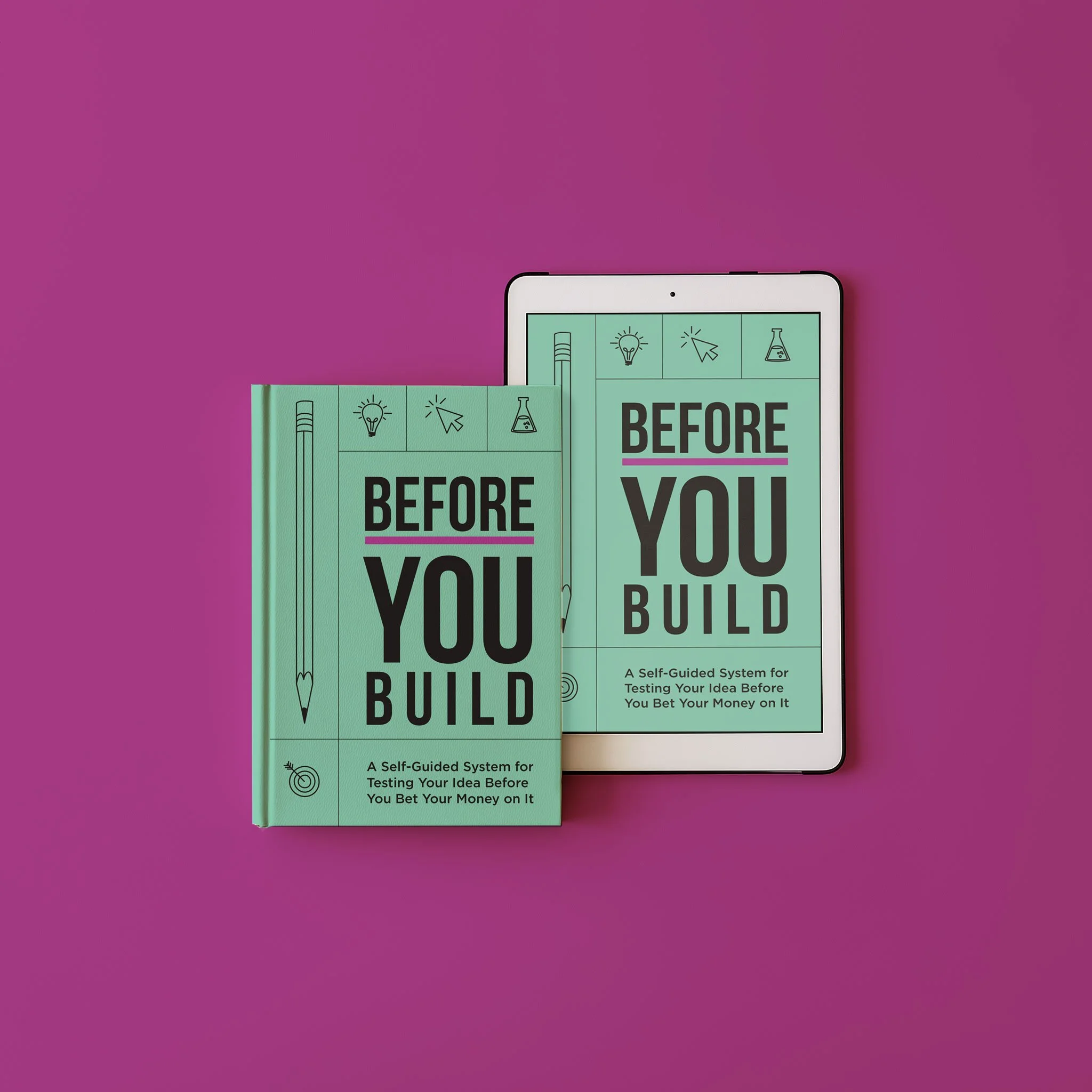
INTRODUCING BEFORE YOU BUILD
Scared of Building Something Nobody Wants?
That's a reasonable fear. Most people with good ideas never build them, and most people who do find out too late that nobody wanted it. This workbook closes that gap, so you know with real evidence whether your idea is worth building before you commit.
Free to join. Early access pricing when we launch.
THE PROBLEM
Your caution isn’t the problem. Guessing is.
Most ideas that fail do so because no one checked demand early enough. Worrying about that is rational. But more months of thinking won't give you an answer. Only evidence will.
You’ve had the same idea, or three of them, for months or years.
You have a job or client work you can't walk away from without real confidence.
Every time you get close to starting, one question stops you: what if nobody wants it?
"Just ship it" advice ignores the thing you're worried about.
You’d rather spend a weekend finding out than six months building blind.
THE SOLUTION
Find out whether it’s worth building before you build it.
Before You Build is a self-guided workbook built around a four-stage process for pressure-testing your idea before you commit. It takes you from "I think this could work" to "here's the evidence for whether it will."
It doesn't tell you your idea will work. It tells you whether it's worth finding out, and gives you a clear next step either way.
HOW IT WORKS
Four stages.
Then a launch plan.
It works because it helps you test your assumptions before you spend. Each stage narrows the uncertainty a little more.
Look at the market before you look at your idea. Find out who already has this problem, what they're doing about it now, and what they already pay for. That gives you facts to work from.
1 Research
2 Ideate
Put your original idea next to the alternatives the research turns up. Structured prompts help you generate other angles, so you aren't betting everything on the first version you thought of.
3 Prototype
Turn your strongest concept into something a real person can react to: a description, an offer, a mockup. Make it just enough to test, and cheap enough to throw away.
Put it in front of the people it's for and gather signal that actually predicts demand. Look for commitments, not compliments. Then decide to build, change, or walk away, and base that decision on what you found.
4 Validate
5 Go to Market
If the evidence says go, you finish with a launch plan: where your first customers are, what to say to them, and what to do first.
WHO’S IT FOR?
Built for people with ideaS.
This is for you if
You have an idea, or several, that you've been thinking about for a long time
You have a job or freelance work and can't afford to bet it on a hunch
You'd rather make decisions from evidence than from gut feeling
You want to start something, and you want to start the right thing
This isn't for you if
You want a guarantee that your idea will succeed. Nothing can give you that.
You've already validated demand and need help building or scaling
×You're looking for motivation rather than a method
EARLY ACCESS
Get it at LAUNCH pricing.
Before You Build is launching soon. Join the waitlist for first access and a discount off the retail price.
LAUNCHING AT
$27
One-time purchase. Yours to keep and reuse.
FAQ
-
No, and nothing honestly can. What it does is reduce the odds that you build the wrong thing. You'll finish with evidence about whether real people want what you're planning, which is a much better basis for a decision than months of thinking.
-
Then the workbook did its job, and it cost you a weekend instead of a year. Many ideas don't fail outright. They just need a pivot… a different audience, format, or angle, and the process usually points toward what to change.
-
About three hours of focused work. Most people finish it in a weekend, and it fits around a full-time job.
-
It's built for ideas you'd sell to people: a product, a service, an app, a digital download, or a side business. If success depends on someone choosing to pay for it, the process applies.
-
A PDF that works on-screen or printed as a workbook, whichever you prefer.
-
Yes. If you have several ideas, run each one through it and compare the results side by side.